
Glen Thielmann
University of Northern British Columbia
Glen Thielmann is a Lecturer at the University of Northern British Columbia. Glen draws on 29 years of geography and social studies teaching for high school students. He is currently pursuing his PhD, and is involved in professional development for teachers. Glen also leads the methods and curriculum course for humanities students in the faculty.

Curriculum in Context
In B.C.’s curriculum, history education is mainly delivered through social studies which offers “considerable flexibility as to how teachers approach history and geography within social studies.” A core part of Glen’s teaching involves training pre-service teachers to embrace historical thinking and related concepts holistically. As he puts it, “One of my jobs as a defender of holistic social studies is to try and create a learning experience, at the university level or at the teacher education level, where they see social studies as more than just a history course.” This means his courses integrate additional competencies, like imagination and empathy, alongside engaging and multi-disciplinary work, ensuring pre-service teachers not only learn to “think like a historian” but also have enjoyable and meaningful experiences.
From Theory to Practice: Curricular Goals in Action
Glen’s teaching philosophy is rooted in a desire to help all students, regardless of their academic background, develop a genuine appreciation for history. For Glen, when pre-service teachers care about history, “they care about their community, they care about the place they live, and they care about the people in their lives.”
One effective strategy Glen employs to initiate this value-driven work is an introductory activity in each course. Students are prompted to reflect on their aspirations for social studies education. They receive a series of cards, each representing a different value relevant to social studies, such as reconciliation, historical literacy, and active citizenship and critical thinking. Working in groups, students sort and rank these cards, engaging in discussions about how their chosen priorities will influence their future classrooms and teaching emphasis. This exercise encourages critical examination of each value’s merits and interdependence. Glen finds such activities “fantastically empowering, because so many students, and even our student teachers, have had bad experiences with social studies, where they think of it as dead boring and not important.” By rooting their practice in identified values, Glen hopes to help future educators move beyond the “piles of worksheets and textbook work” often found in social studies classrooms.
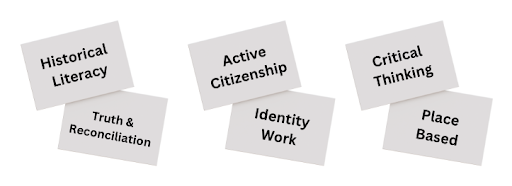
Examples of values given to students to rank and consider as goals for teaching history and social studies.
With these foundational values in mind, Glen then guides his students toward meaningful and accessible historical inquiry. He emphasizes that “students at almost any level can engage in historical thinking just by asking questions about then and now.” To illustrate this, Glen uses what he calls a “provocative hook or invitation for students to think about,” often a primary or secondary source.
For instance, a compelling lesson Glen has done involved a series of historical paintings depicting Indigenous life by Paul Kane. Without providing prior historical context or critiquing Kane’s portrayal, Glen invites students to discuss the painting in groups using a series of guiding questions. After initial annotations of the first painting, he introduces several other connected portrayals or related sources, allowing the conversations and annotations to continue evolving, gradually unpacking the affordance and limitations of Kane’s portrayals.
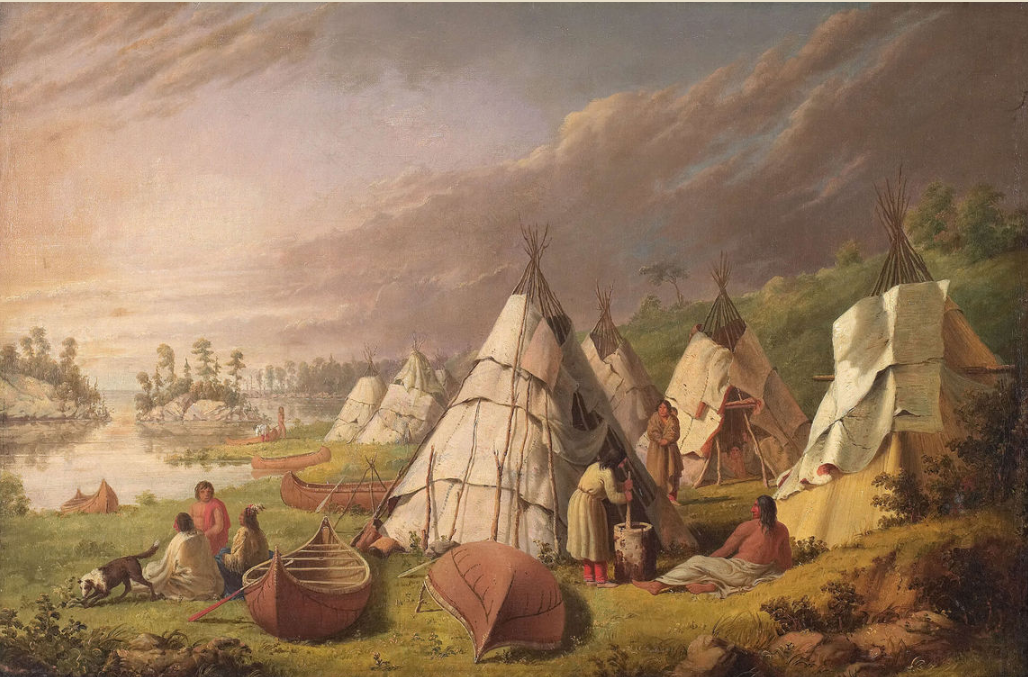
Paul Kane, Indian Encampment on Lake Huron, c. 1845, oil on canvas, 48.3 x 73.7 cm, Art Gallery of Ontario, Toronto. https://www.aci-iac.ca/art-books/paul-kane/significance-and-critical-issues/
Given that this activity follows the initial values task, Glen finds that students often approach it with emerging metacognitive awareness and a pedagogical lens. “It’s one of those things that kind of inspires them, that you can do something very simple, that, from the teacher’s point of view, was not hard…They’re doing the heavy lifting, and they realize that you can have a cool lesson in which students are engaged to whatever extent they want to be engaged.” Glen also highlights that the powerful opportunities for self-reflection, observation, and rich conversations can emerge as authentic forms of assessment in such tasks.
Navigating the Complexities of Teacher Preparation
Glen aims for his inclusive approach to make history and social studies feel more relevant to students’ futures. He also sees the discipline as a vital avenue “to create avenues for literacy intervention in secondary schools.” It’s crucial, he believes, for pre-service teachers to learn strategies that promote literacy and confidence with diverse texts, including digital media. Glen also notes that “social studies teachers have a huge burden to actually lift historical consciousness out of the textbook and make it relevant to challenge conspiratorial thinking with historical and critical thinking.” He therefore fosters critical thinking to help students build media literacy and critically evaluate the content they consume.
For Glen, teaching about the past requires a holistic, engaging strategy. Beyond just teaching students to “think like historians,” he stresses fostering passionate, value-driven involvement in social studies. He advocates aiming for “engagement…empathy and some sense of historical consciousness, even if it’s a starting position, just getting them to care a bit about history and make bold assumptions about the present based on their developing knowledge of the past.”
Co-created by Glen Thielmann and Jessica Gobran