Dr. Sara Karn
McMaster University
Dr. Sara Karn is a Postdoctoral Fellow at McMaster University and Thinking Historically for Canada’s Future. Her doctoral research at Queen’s University focused on historical empathy within history education in Canada. She teaches environmental and climate education and social studies education through a history lens at Wilfrid Laurier and Lakehead Universities. She also collaborates on climate justice education projects with the Social Studies & History Education in the Anthropocene Network (SSHEAN), led by Dr. Heather McGregor at Queen’s.
Curriculum in Context
Dr. Karn strives to tailor her teaching to the specific contexts her teacher candidates are in, particularly focusing on local histories and environments. For instance, when she teaches environmental education at Laurier’s Brantford campus, she highlights the histories of the Six Nations of the Grand River and facilitates a river walk with teacher candidates.
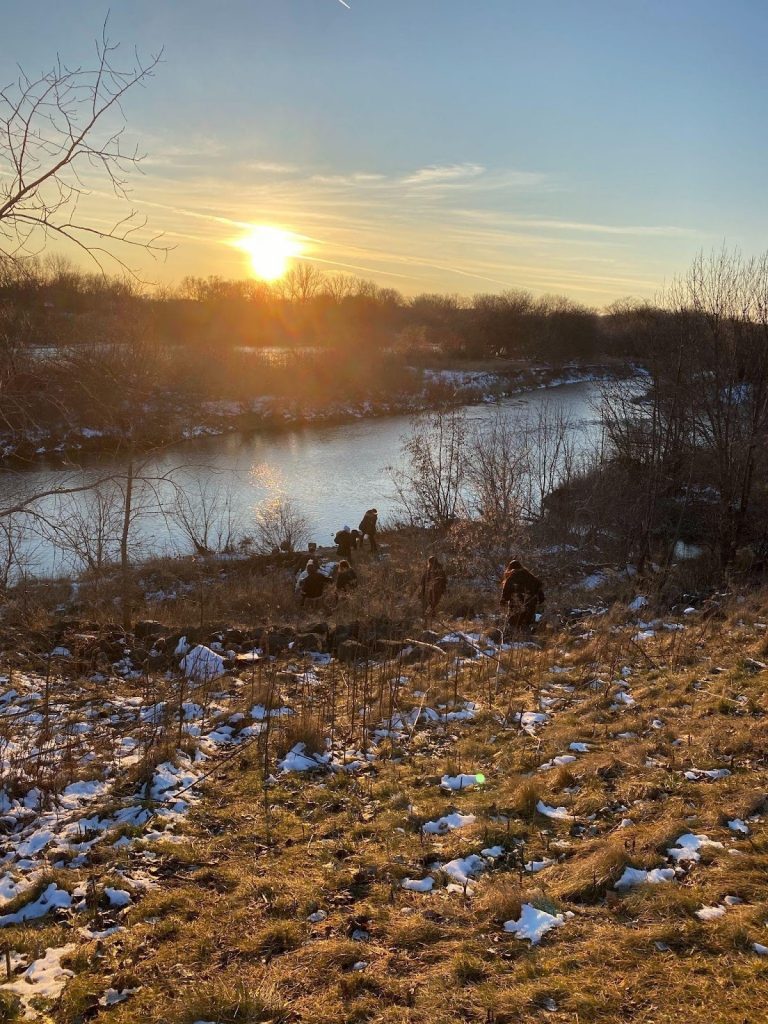
Teacher candidates on a river walk along the Grand River in January 2023. Photo provided by Dr. Karn.
Dr. Karn’s current work in environmental and social studies education builds on her dissertation, which explored historical empathy. She currently considers how we can teach about the past in light of the climate crisis, and considers the ways that emotions can be implicated in this work. Dr. Karn emphasizes that “emotions inevitably come into the classroom, no matter what the subject is. It’s an important part of the learning experience.”
From Theory to Practice: Curricular Goals in Action
Dr. Karn approaches environmental and climate education as interdisciplinary, viewing history as “one piece of the larger puzzle when it comes to climate issues.” Her primary goal is “to foster empathy and care for humans, more-than-humans, and the environment, in the past and present,” often through outdoor learning experiences. For Dr. Karn, this process is both relational and critical, inherently involving emotional or affective dimensions. By engaging students in this way, Dr. Karn hopes to “empower them and their future students to take action on a variety of different environmental issues.”
One method she employs with teacher candidates is the “Prompt for the Planet” task, inspired by poet Amanda Gorman. This interdisciplinary exercise prompts students to choose an element from the environment and, through an art-based response, speak in its voice. For example, students might explore what raging forest fires would communicate to the world or what fresh water in Ontario’s Great Lakes might say. Dr. Karn notes the elements chosen are often deeply personal: “They don’t just choose water or trees in general. They often pick, for example, a particular tree from their family’s farm, so there’s a family history and identity piece that motivates their response and care with the natural phenomenon.”
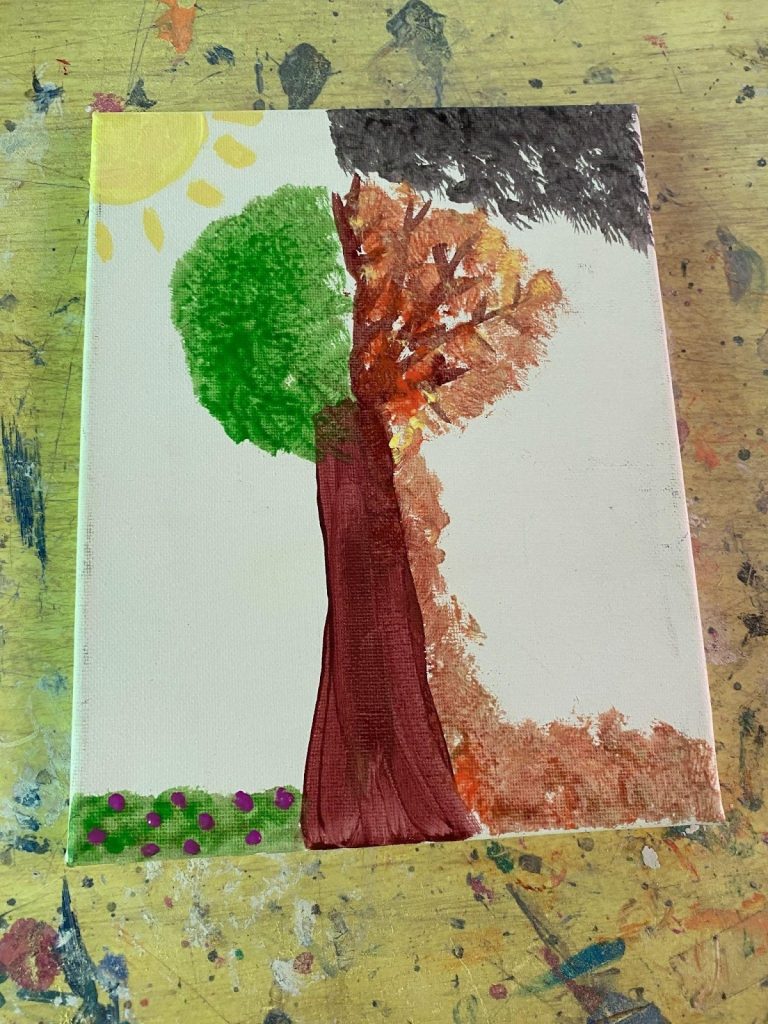
An example of a Prompt for the Planet painting created in June 2025. Photo provided by Dr. Karn.
This task is also rooted in historical thinking, as these elements can be contextualized across different times and places. For Dr. Karn, this exercise activates a historical consciousness that engages emotional and creative faculties. She believes it “really brings together the past, present, and the future when they consider how their element has been impacted by climate change over time.”
By fostering care and empathetic relationships with the environment, Dr. Karn aims to impress upon teacher candidates that “responding to the climate crisis requires an understanding of where we’ve come from and where we’re headed in the future.” She further deepens this understanding through other activities that emphasize imagination in comprehending the past, present, and what Dr. Kent den Heyer terms “preferable futures” for addressing environmental degradation.
Dr. Karn frequently uses Dr. Gillian Judson’s “walking curriculum,” where students discuss questions, such as, “What evidence can you find of something that’s happened in this place before now?” while walking outdoors, which helps students “develop a sense of place over time outside of the four walls of the classroom.” In other instances, students create “climate story videos” chronicling the history of a significant place and how it has been affected by climate change. Collectively, these assignments “ground students in the reality of the present and what has existed in the past, and teach them to use history to ground their reflections.”
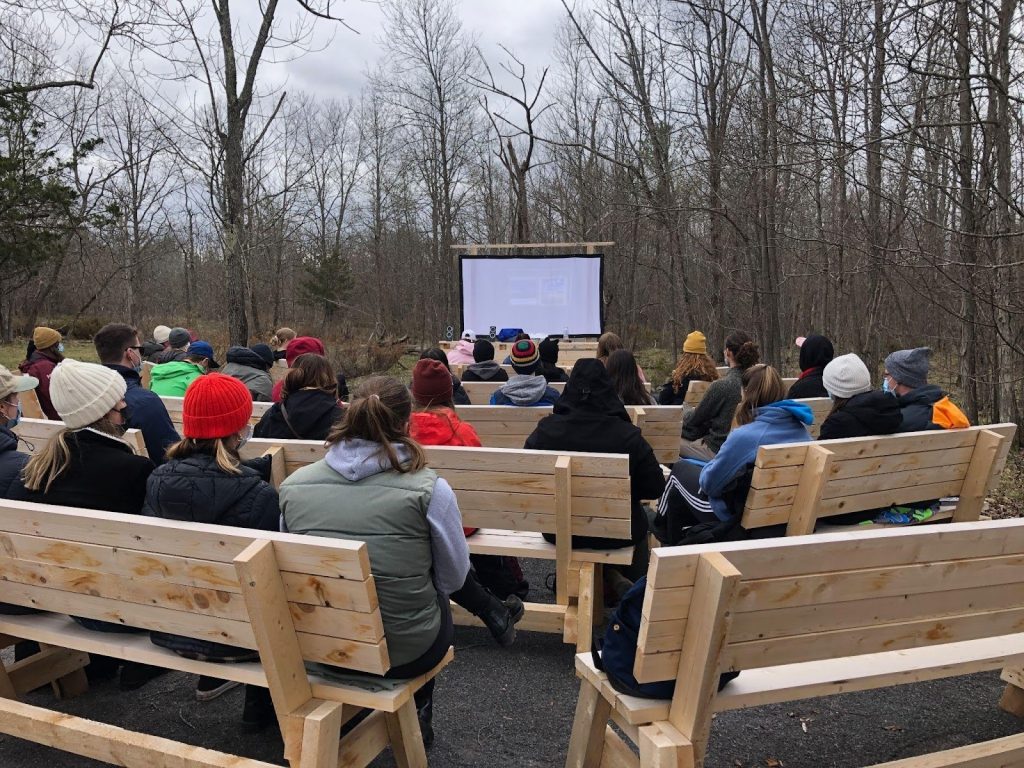
Teacher candidates gathered outdoors at Elbow Lake Environmental Education Centre to watch climate story videos in April 2022. Photo provided by Dr. Karn.
Navigating the Complexities of Teacher Preparation
Dr. Karn recognizes that history is not always intuitively associated with environmental and climate education and traditional educational structures often silo subjects. To counter this, she continues to champion an interdisciplinary approach, modeling how history can intertwine with all subjects.
Teaching across multiple institutions also presents challenges for fostering deep connections with local lands and histories. This difficulty, however, motivates Dr. Karn to collaborate with local instructors and knowledge holders, reinforcing a commitment to lifelong learning about the places central to her teaching. As she puts it, “It’s important for me to get to know the place alongside the students, especially in our interactions outdoors. We’re never really done learning about or from the land.”
Co-created by Dr. Sara Karn and Jessica Gobran