Dr. Paula Waatainen
Vancouver Island University
Dr. Paula Waatainen is a professor (unranked) in the Faculty of Education at Vancouver Island University. She taught as a high school social studies teacher for 21 years before becoming a teacher-educator and completing her doctorate in Educational Research in the Learning Sciences at the University of Calgary (2022). She aspires to prepare teachers to create opportunities in social studies classes for students to do interdisciplinary work that connects to real-world problems, processes, and places.
Curriculum in Context
When reflecting on her curricular context, Dr. Waatainen highlights the structure of the K-12 social studies curriculum in B.C., which integrates geography, history, and civics as an interdisciplinary subject to grade 10. As a result, she views her “role not as preparing history teachers,” but as preparing well-rounded social studies educators.
During her time as a high school teacher, Dr. Waatainen contributed to the B.C. social studies curriculum writing team, helping revise it to focus on building conceptual understanding and competencies. She explains that before, “teachers had these big lists of treaties, battles, and more to cover. Now, teachers are supposed to teach broad concepts, like colonialism, revolution, or governance, and can choose their own case studies that are relevant to them and their students.” She acknowledges that this shift presents a “learning curve”, especially as educators must now assess student learning using a “proficiency scale capturing growth in student competencies in things like perspective-taking, use of evidence, ethical judgement and understanding causation.”
In response, Dr. Waatainen draws on Peter Seixas’s work on historical thinking, which is now embedded in the curriculum. While historical thinking offers powerful opportunities to “problematize” history, she also recognizes that in practice, it can overshadow geographical and civic thinking, which are equally vital to the interdisciplinary nature of social studies. She aims to address this through her intentional design for interdisciplinary learning.
From Theory to Practice: Curricular Goals in Action
As a teacher educator, Dr. Waatainen shares that her curricular goals for students are to “build their professional competencies and their ability to respond to a novel situation, by drawing on their knowledge, skills, and dispositions.”
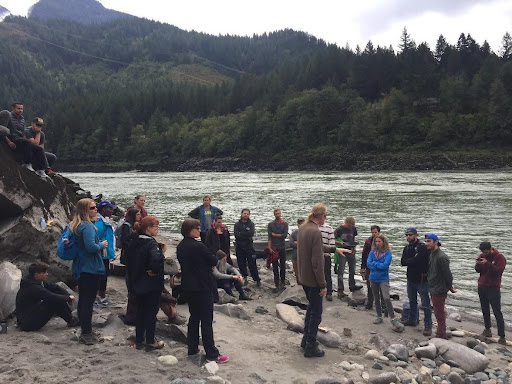
One way Dr. Waatainen accomplishes this is by integrating place-based learning and design thinking in her social studies methods course through field trips, often with colleagues. In 2018 and 2019, Dr. Waatainen and her colleague Dr. Teresa Farrell took students to the Fraser Canyon for place-based learning field schools with Elders and disciplinary experts. Each year, she collaborates with colleague David Sufrin to design an interdisciplinary social studies and math field trip to downtown Nanaimo. Students work in small groups and complete a variety of tasks, including using the app On This Spot to visit historical sites in their location. During this trip, students engage in urban planning and conduct a site assessment on places that could benefit from redesign, through an assessment of strengths, weaknesses, and opportunities.
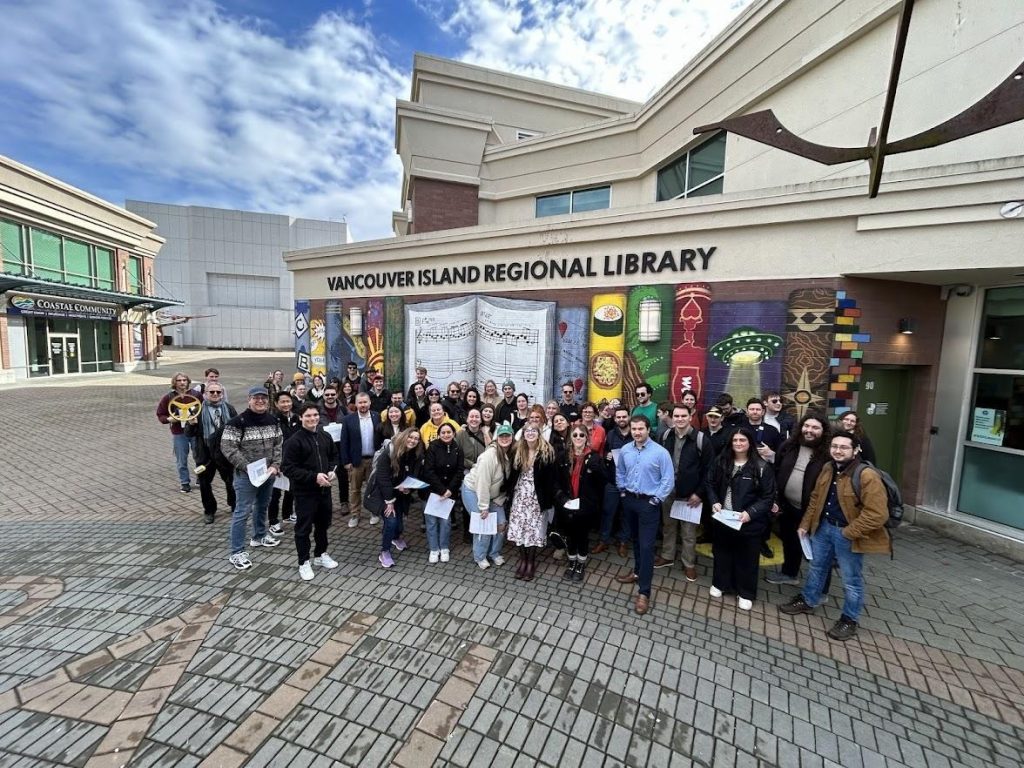
A portion of this trip is also spent in the museum, where students are challenged to engage with an exhibit critically and with their curator hats on. Dr. Waatainen prompts them with questions like, “What would you change about this? What would you add to the museum that’s not there?” She shares her rationale for a multi-dimensional hands-on learning: “I want them to be engaged. I want them to feel inspired and connected to each other, to the place, because I want them to remember how powerful that is, in the hopes that it’s going to make them value getting outside of the box of the classroom.”
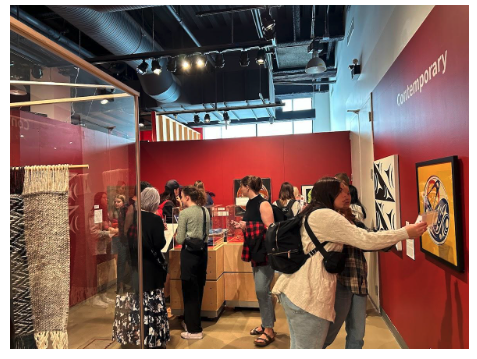
Photograph provided by Dr. Waatainen of her students interacting with artifacts during a field trip to the Nanaimo Museum. For a list of museum activities and a description of a teacher professional day that Dr. Waatainen, Dr. Lindsay Gibson, Chris O’Connor and Brent Geerts led at the Royal BC Museum, see this blog https://wordpress.viu.ca/authenticlearning/thinking-critically-about-museums-in-old-town/
Afterwards, students in her secondary education cohorts design plans to connect active discussion and participation in current issues to a history unit, while students in her elementary education cohorts complete an assignment called Building Social Studies and Interdisciplinary Competencies in Place Videos that has them design a place-based learning field trip for their students. She emphasizes the flexibility and advantage of engaging with local places in response to their classroom context: “It could just be the stream behind their elementary school, or an urban place, where they can film themselves describing the context that they’ve learned about the place and how their students will think historically, geographically, or politically there.”
Additionally, Dr. Waatainen shares how she incorporates historical consciousness in her teaching through the concept of collective memory, which she routinely embeds through her course: “The entry point to this idea is that we belong to communities that have a collective memory of the past. I get my students to think about where and when they are situated. Thinking about who has walked here before. Why is it this place? Why is it this way? Who made it that way?”
Navigating the Complexities of Teacher Preparation
Dr. Waatainen identifies several competing needs of students that they consider important in preparing them for the teaching field. As a result, she recognizes the necessity of teaching students how to teach concepts, build competencies, and assess them. She does this by engaging students in productive dialogue that offers insight and challenges them to grapple with real-world problems and contemporary classroom adversities through collaborative conversations.
She shares that she does this confidently because of her strong academic colleagues, with whom she collaborates on lessons and addresses broader ideas through a division of work. This ensures students receive a comprehensive education while allowing each professor to focus on the quality of teaching. Dr. Waatainen shares, “They’re not going to leave my course with anywhere near everything that they’re going to need. They’re going to continue having to learn, but I’m hoping that what I’ve demonstrated has gotten them excited about some really cool practices.”
Co-created by Dr. Paula Waatainen and Tracy Dinh