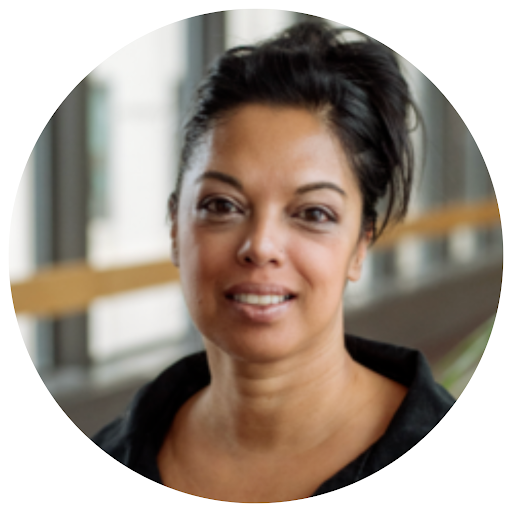
Dr. Nadia Delanoy
University of Calgary
Dr. Nadia Delanoy is an Assistant Professor and the Director of Student Experience at the University of Calgary’s Werklund School of Education.
She has taught within the K-12 system, including subjects such as Social Studies, IB (International Baccalaureate) History, Economics, and International Politics. Dr. Delanoy works to empower her students through authentic storytelling and reflection.
Curriculum in Context
Drawing from her experiences, Dr. Delanoy acknowledges the challenges in preparing future educators to teach social studies and history, including “interpreting the program of studies, figuring out what’s important, and being able to contextualize it for students from multiple backgrounds.”
However, Dr. Delanoy emphasizes that these challenges are an ever-evolving practice that only orbit the core of teaching. Rather than centring her work on these common obstacles, she prompts her students to deconstruct and develop their teaching identities. Understanding that teacher preparation affords limited time with students, she facilitates learning through identity, explaining that “Your identity underpins everything. How you interpret language, how you engage with people, what you do in the classroom, and how you understand students or don’t.”
As a teacher educator, Dr. Delanoy’s goal is to encourage students to consider how they are situated in society and in teaching and learning. She shares that by seeking to understand one’s own truths and biases within “the broader context as teacher, as learner, and so on,” educators can better navigate multiple perspectives, recognize the importance of withholding personal bias, and support students in developing these same critical skills.
From Theory to Practice: Curricular Goals in Action
When discussing Dr. Delanoy’s broader goals for teaching in the past, she emphasizes the importance of what she describes as the life curriculum. Grounded in her belief in the power of honouring story, she recounts moments in which students felt safe to share their personal connections to the curriculum. These stories included Indigenous students reflecting on lineage, displacement, and treaty, alongside peers who shared how engaging with these truths reshaped their own understanding of history in its contextual past and its ongoing significance in the present.
Dr. Delanoy explains that this depth of sharing is only possible when a classroom is built on trust, safety, and mutual recognition. She reflects, “our class trusted each other, and our class wanted to share and sign into the hard conversations. When we were talking about curriculum, we were talking about the life curriculum and embodying it.” Within this environment, students felt empowered to ask questions that were politically daunting yet necessary, as part of a meaningful engagement with history and the curriculum.
At the core of this powerful practice, Dr. Delanoy seeks to cultivate authentic learning through the intersection of history, curriculum, and identity. She shares that “when you’re able to deconstruct your sense of self, and position yourself in an anthropological and sociological vein in society and how it relates to the classroom, you are better prepared to respond to the realities of contemporary classrooms.” These realities include teaching students who have arrived from war-torn countries, or those who have grown without access to basic resources, including “students who didn’t even know what they looked like because they didn’t have a mirror.” Through this lens, teaching the past becomes inseparable from teaching students how to locate themselves, and one another, within the world they are actively navigating.
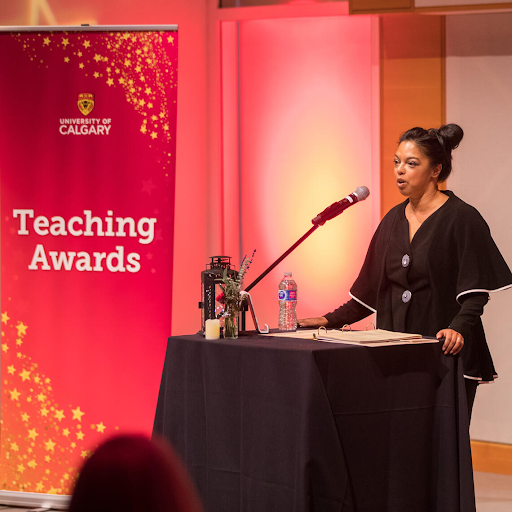
Image of Dr. Nadia Delanoy’s acceptance speech at the University of Calgary Teaching Awards Ceremony, 2023
When asked about her understanding of historical consciousness, Dr. Delanoy explains that there are particular moments and contexts in which we must look in and at history to understand what is taken up as ‘real’, how meaning is constructed, and how the past continues to inform the present. She notes the dominant configured historical timeline within traditional teaching methods has been disrupted by the Covid-19 pandemic, observing that “students may not actually understand the connections of history to now.” In response, she emphasizes the need for educators in the pre-service teacher program to be explicit in how learning is designed, explaining that we must design “not for peoples, places, events, and dates, but for ideological and conceptual understandings of what those events brought and did to the fabric of society.” Through this approach, Dr. Delanoy positions historical consciousness as a tool that supports her commitment to authentic learning, rather than the reproduction of historical facts.
Navigating the Complexities of Teacher Preparation
One challenge Dr. Delanoy identifies in preparing pre-service teachers to teach social studies and history is designing learning experiences that foster both engagement and competency-based learning. She notes that many pre-service teachers are drawn to the field because they find it deeply compelling, yet “social studies is ranked one of the lowest engaging classes in K-12 studies.” This tension frames a central question in her work with teacher candidates: “You love this, but how do you get others to love this?”
In response, Dr. Delanoy emphasizes the importance of being explicit about what and why educators teach within the field of social studies and history. Returning to concept-based and competency-based approaches, she focuses on skills such as critical thinking and reflection, and challenges her students to reframe the subject by “playing around with story and contextualization.” Through this approach, she underscores that social studies education is not only about context acquisition, but about human development: “you’re not just building the brain, you’re building the human.”
Co-created by Dr. Nadia Delanoy and Tracy Dinh