Dr. Mark T.S. Currie
Carleton University
Dr. Mark T.S. Currie is an Adjunct Professor at Carleton University. He previously taught intermediate and senior social studies and history education courses at the University of Ottawa. Dr. Currie also taught social studies and Indigenous education at OISE, University of Toronto, and is a researcher and writer for an educational consulting company.

Curriculum in Context
Dr. Currie guides pre-service teachers to view curriculum as a “living document,” adaptable to specific teaching contexts rather than a rigid instruction manual. He challenges the common expectation for a clear-cut guide to history teaching, and emphasizes that curriculum “is a changing thing that shifts in priorities and focal points over the years.”
Instead of feeling “handcuffed” by the curriculum, Dr. Currie encourages his students to embrace the curriculum’s broad ideas and skills as parameters. Within these, they can “push the boundaries a bit and adapt from year to year and class to class.” He advocates for finding unique content and pathways that resonate with the students and the community. Acknowledging that this can be challenging, he motivates teacher candidates to focus on “building careers, not just a job for right now,” urging them to cultivate a “foundational understanding and approach that works for them and will sustain them as teachers over the years.”
From Theory to Practice: Curricular Goals in Action
Dr. Currie’s teaching philosophy challenges the notion of a rigid, checklist-based approach to history education. He begins each class by telling teacher candidates, “I’m not here to teach you exactly how to teach history, but I am here to help you figure out what kind of history teacher you want to be.” This approach, he reflects, “gives them permission to find their own way.”
Central to this journey is self-reflection and self-understanding. Dr. Currie emphasizes, “You have to start with yourself and understand what you know and what you don’t know.” He believes that by acknowledging their own assumptions, students can grasp that “there is no single ‘capital T’ Truth in history – or, if there is, we spend our lifetime in search of it.” He encourages teacher candidates to explore the multiplicity of narratives and perspectives, stressing that “history is something we create, not something we just receive and accept.”
To foster this reflexive work and illustrate diverse perceptions, Dr. Currie uses an activity centred on personal artifacts and histories. Students identify a meaningful artifact from their homes and write its story in relation to their lived experiences and family history. Dr. Currie often uses old, wooden, Coca-Cola crates as an example, initially showing empty crates and asking students to reflect on their meaning. After hearing various interpretations of their age, use, and origins, he reveals a photo of the crates filled with his books, explaining they serve as his bookshelf. This demonstrates how “everyone has a different historical connection to places, spaces, and objects,” forming a foundation for considering diverse perspectives in class.
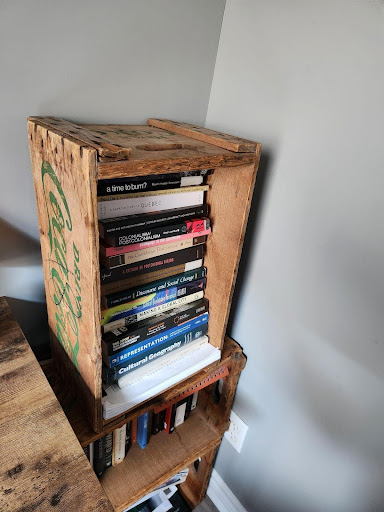
Dr. Currie’s old, wooden Coca-Cola crates that function as a bookshelf. Photo provided by Dr. Currie.
In one instance, a student shared a photo of a historical Spadina house in Toronto. While many recognized it as a museum, the student revealed it was her grandmother’s house where she had played as a child. Dr. Currie noted, “to her, it’s her grandma’s house, but to the surrounding community, it’s a historical house that needs to be preserved.”
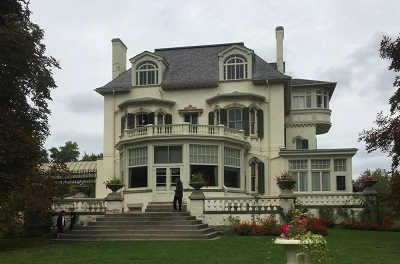
An example of a historic Spadina house in Toronto, similar to the one reflected on by one of Dr. Currie’s teacher candidates. Parks Canada. (n.d.). William D. Lawrence House [Photograph]. https://www.pc.gc.ca/apps/dfhd/page_nhs_eng.aspx?id=15735.
This task helps create a sense that “everybody is a historical figure because we reshape the world in our own ways. It’s all about how we show the perspective that we see people and things in.” Through this activity, Dr. Currie shows pre-service teachers how their own experiences shape their interpretations of people, experiences, and artifacts, and how openness to diverse perspectives leads to more relational readings. He believes such activities help history and social studies educators avoid “compartmentalizing the past, present, and future” in their pursuit of historical thinking and consciousness.
Navigating the Complexities of Teacher Preparation
Dr. Currie employs a critical, anti-racist lens to “push and disrupt the grand, colonial narrative and status quo.” Acknowledging pre-service teachers’ concerns about potential pushback, he emphasizes that this pedagogy “helps us to see things in the complex and relational ways they exist,” better positioning us for future change. He notes that recognizing colonial and racist dynamics “becomes how you approach yourself in the everyday world.”
Dr. Currie also reflected on challenges for teacher educators facing resistance to this approach in their practice. While the impulse may be to “shut it down” when teacher candidates disagree with an anti-racist approach, he cautions, “you can’t just shut it down, if you want to show critical thinking and critical understanding. If you want to be critical, you have to engage.” He advocates for an open, engaging approach to disagreement, modelling dispositions beneficial for future educators.
Co-created by Dr. Mark T.S. Currie and Jessica Gobran