Dr. Jennifer Tupper
University of Alberta
Dr. Jennifer Tupper is currently serving in her second term as the Dean of Education at the University of Alberta. She previously held roles at the University of Regina, including Associate Professor, Secondary Program Chair, Associate Dean and Dean.

Curriculum in Context
Early in her career, Dr. Tupper taught a secondary social studies class as part of the high school upgrading program at Alberta College that included newcomers, refugees, and Indigenous students – many of whom were residential school survivors, a fact she only later understood. A pivotal moment occurred when an Indigenous student challenged the Eurocentric curriculum in her Social Studies 10 course, questioning her neglect of Indigenous perspectives in her teaching. This led Dr. Tupper to “recognize the limitations of [her] own knowledge” and how her teaching was “reproducing a dominant, white-settler, white-supremacist foundation.”
This profound realization, which Dr. Tupper calls “the most significant, impactful, and pivotal moment for me as an educator,” continues to anchor Dr. Tupper’s work. “I hold that student’s voice in my mind all the time,” reflected Dr. Tupper. She remains committed to addressing “the continued limitations of [her] own knowledge and understanding” and improving support for Indigenous, racialized, and historically marginalized learners in higher education, both as a teacher educator and leader.
From Theory to Practice: Curricular Goals in Action
Dr. Tupper’s educational philosophy centres on the belief that all educators must engage in the process of learning and unlearning. This means recognizing how our educational experiences are, as Dr. Marie Battiste puts it, “marinated in Eurocentrism.” Dr. Tupper feels “an ethical and moral obligation to disrupt dominance and colonialism.”
Dr. Tupper’s own anti-colonial teaching journey began in Saskatchewan, where she was invited to a research project on best practices in treaty education. Working with Indigenous elders and knowledge keepers, she “came to see the power and disruptive impact of treaty education” as it offered “a different way of understanding the world.” She integrated this into her teaching, focusing on guiding students to explore treaties in their own communities and connect them to broader notions of history.
In 2012, Dr. Tupper undertook “Project of Heart” with her pre-service social studies students. This initiative was created by Sylvia Smith and invites students to learn about the history of residential schools in their communities alongside Indigenous elders, knowledge keepers, and survivors. A key component of Project of Heart is having participants paint wooden tiles to reflect their learning, many of which have been used to create a mosaic which is now a permanent installation at the Canadian Museum of Human Rights.
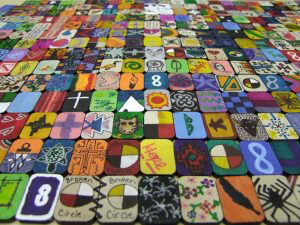
Project of Heart tiles painted by students. Image provided by Dr. Tupper.
Dr. Tupper facilitated this with her teacher candidates and a local high school class, with Indigenous artist and knowledge keeper Joseph Naytohow leading a powerful ceremony during the tile painting. Despite logistical challenges that can make this kind of community work daunting for educators, Dr. Tupper believes efforts such as this “unfold in all the ways that they need to. I think the Creator always has a way of making these things happen.”
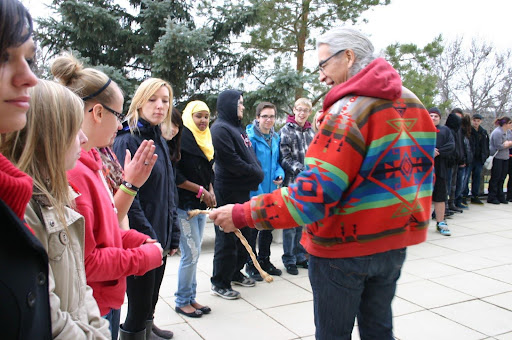
URegina teacher candidates and Regina public high school students participating in ceremony alongside Joseph Naytohow for the Project of Heart Initiative in Fall 2012. Image provided by Dr. Tupper.
Beyond this project, land-based learning remains essential to Dr. Tupper’s approach to history education. With a group of teacher co-researchers, Dr. Tupper spent time at the Regina Indian Industrial School (RIIS) cemetery, located at the former RIIS site just outside the city. Elder Noel Star Blanket joined them for a ceremony, and taught these educators about honouring the children buried there in unmarked graves. This experience, she reflected, “created a new way of orienting to the landscape, and thus a new way of thinking about our own teaching and learning.”
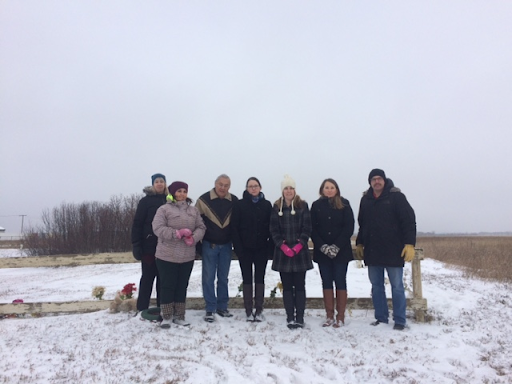
Place based learning with Elder Starblanket at the unmarked graves on the site of the former Regina Indian Industrial School in Winter 2017. Image provided by Dr. Tupper.
Navigating the Complexities of Teacher Preparation
Dr. Tupper reflected that resistance to difficult knowledge adds complexity to her work and commitments in teacher education. She remembers her “own ignorance many years ago,” and that “people are at various stages and places of knowledge and understanding regarding oppressive structures and processes of education systems.”
She noted that it is important not to be afraid of resistance, but to help students “find ways to embrace it and navigate through it.” Her work with elders has taught her that “it’s so critical to continue to extend the invitation to a space of learning and seek to understand why somebody believes what they believe, or why they might be pushing back.”
Amidst the growing backlash against equity initiatives that she observes in Alberta, Dr. Tupper employs strategies like settler life writing to help students “excavate ignorance and then move through the world differently.” This reflective process, often centred around artifacts, helps to gently “create cracks” in settler historical consciousness.
Fundamentally, Dr. Tupper reflects that she, and many of her students, have the privilege to “come in and out of this work, but there is no opting out of it for Indigenous people who must always carry the weight of colonialism and racism.” Dr. Tupper remains committed, guided by advice once given to her by Elder Star Blanket: “You must always use your position to make a difference, and you must always use your privilege because you have it.”
Co-created by Dr. Jennifer Tupper and Jessica Gobran