
Dr. Alan Sears
University of New Brunswick
Dr. Alan Sears, Professor Emeritus of Social Studies Education at the University of New Brunswick, began teaching in public schools in 1977. After teaching for 11 years, he transitioned to a university position where he focused on social studies and history education. Dr. Sears continues to be a prominent voice in the field of history education through his research and publications.

Curriculum in Context
Dr. Alan Sears’s work in curriculum and textbook development provides him with a broad Canadian perspective on the context of history education. While he observes that provincial curricula aren’t vastly different across the country, he notes that demographics and provincial policy norms can influence implementation and areas of emphasis.
Dr. Sears stresses the vital role of teacher educators in preparing future teachers to engage with the systems that create curricula. As he noted, “I have a job to help pre-service teachers get ready to teach the curriculum that’s in New Brunswick. We have a job as teacher educators to get pre-service teachers ready to fit in but not stay there.” He believes educators must not only deliver curriculum but also understand and participate in its creation. Both teachers and students should “know what the system is so that they can work in it but also be able to shape it.”
From Theory to Practice: Curricular Goals in Action
Dr. Sears often utilized a problem-based learning approach to teaching history, involving teacher candidates in working through common issues in professional practice. This method is widely used in professional education in medicine, engineering and other fields.
For Dr. Sears, contestations and controversy around commemorations can be helpful in exploring shifts in history education. He explains, “One of the things that’s happened in history education is that we used to teach what historians know, or the content. Then we shifted, if you think about Historical Thinking, to focus on how historians know…I think the next step is to examine how history, or the past, works.”
For Dr. Sears, commemorations offer a lens for students to analyze how groups remember themselves and how narratives can clash. He illustrated this with the 2017 protests for and against the Lord Cornwalis statue in Halifax, where members of the Mi’kmaq and “Proud Boys” clashed, as shown in the image below. Both groups, he observed, were informed by the past and used this information to think about themselves and how they stood in relation to others. Dr. Sears suggests that “if we are going to meet in these shared spaces and argue, deliberate, or talk about the past, it would be helpful if we had some sense of that, of how people were coming to their understanding of it.”
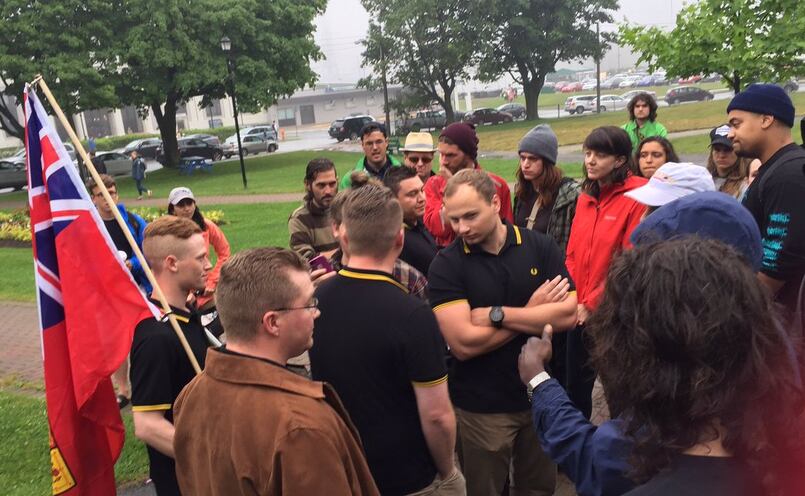
Frances, W. (2017, July 15). “Offensive and disgraceful”: protesters cheer as city of Halifax shrouds Cornwallis statue. CBC News. https://www.cbc.ca/news/canada/nova-scotia/cornwallis-statue-halifax-protest-removal-1.4206909
These ideas came to action during an elementary social studies course Dr. Sears taught to distance B. Ed. students teaching in Montreal’s Jewish private schools. Students were asked to critically analyze a commemorative object, site, or ceremony, and explore its contribution to collective memory and its potential for use in history education. Students had the creative freedom to showcase their learning in a modality of choice. One pair of students chose Stolpersteine Stones. These “tripping stones,” embedded in sidewalks throughout Europe, are designed to “trip up your thinking” and prompt viewers to commemorate Holocaust victims. This pair of students reflected on their learning by creating a podcast that involved one of their grandmothers, who was a Holocaust survivor. While reflecting on these students’ work, Dr. Sears shared that “when you open assignments up, allow them some choice and freedom around how they’re going to respond, and set high standards…students will often do things beyond what you expect.”
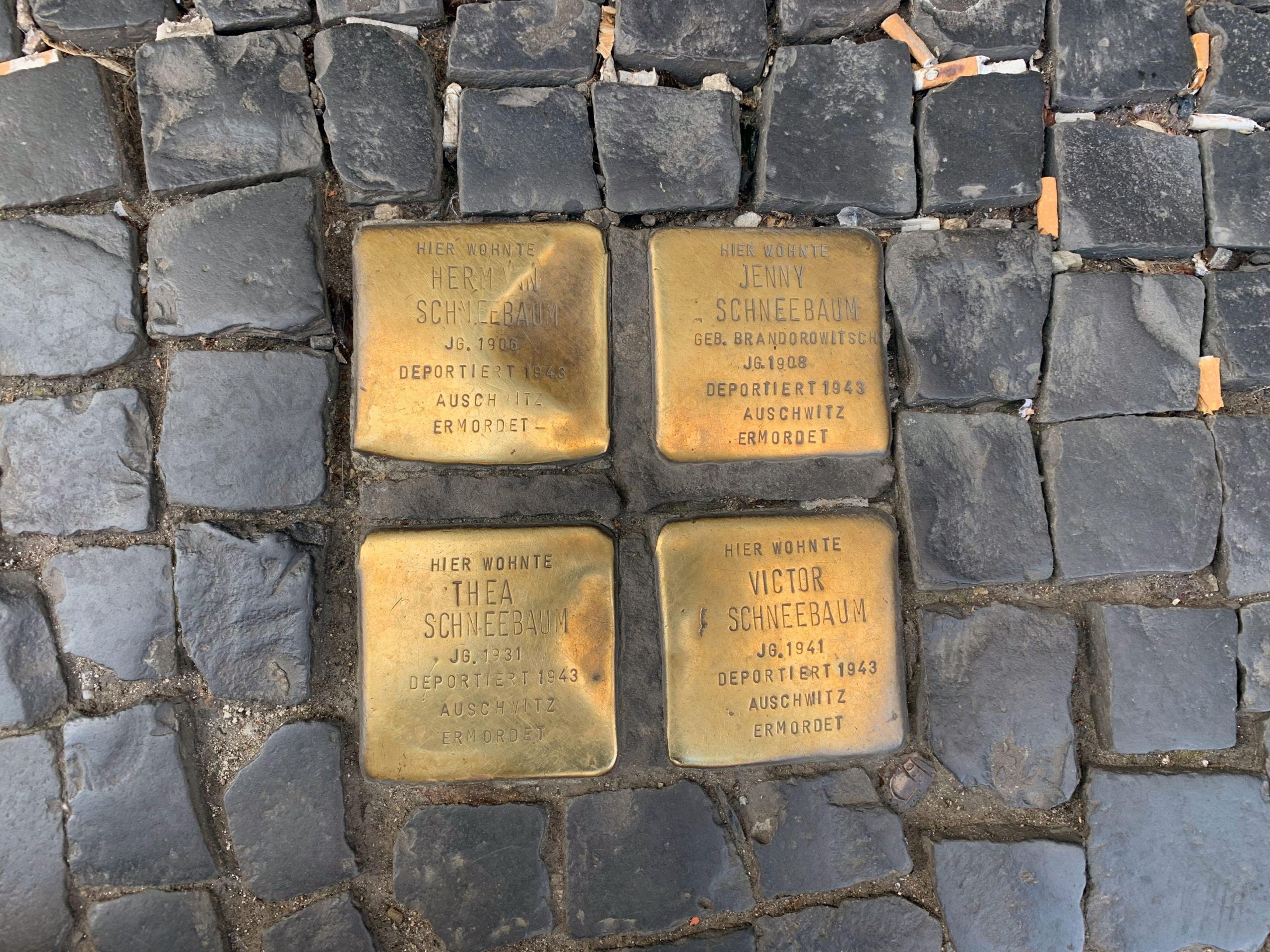
Gunter Demnig, & Catherine Tedford. (2019, July 8). Stolpersteine. The Streets are Talking: Public Forms of Creative Expression from Around the World. St. Lawrence University. https://jstor.org/stable/community.34492645
Dr. Sears stressed that commemorations are valuable for history education, even without controversy: “You don’t have to wait until somebody wants to tear down a statue or change the name of the building to begin to investigate commemoration.” Everyday commemorative practices, like Remembrance Day poems or singing “O Canada,” can help students understand how histories are constructed, shared, and how democratic values can guide respectful commemoration in the future.
Navigating the Complexities of Teacher Preparation
Dr. Sears critically reflected on Canada’s after-degree B.Ed. programs, noting that teachers often earn a history degree, then a teaching degree, then never revisit evolving historical scholarship. He states, “The history profession is changing every year – what historians believe about the past, what evidence they use, who writes about it.” For Dr. Sears, a dynamic understanding of history is crucial for educators who desire to use history to tackle complex civic issues. When used in this way, history can teach humility and the constant search for what he describes as “the best description of how the evidence fits together” and a continual openness to new evidence. Ultimately, Dr. Sears reflected that, “Education is for helping create people who can help us shape the world, not who fit in the world as is. History contributes to that.”
Co-created by Dr. Alan Sears and Jessica Gobran