Dr. Rose Fine-Meyer
University of Toronto
Dr. Rose Fine-Meyer is a Senior Lecturer in the Master of Teaching program at the Ontario Institute for Studies in Education (OISE), University of Toronto. Her 20 years of experience as a secondary school teacher and her public history work at OISE help inform an interdisciplinary approach to history education. Dr. Fine-Meyer is also the president of the Ontario Heritage Fairs Association.
Curriculum in Context
Dr. Fine-Meyer highlighted the way that the OISE invites pre-service teachers to engage in rigorous and current scholarship as they prepare to engage with the provincial curriculum. She notes, “They are on top of the scholarship in the field,” which empowers students to thoughtfully engage with the evolving landscape of history and social studies education.
In Dr. Fine-Meyer’s classrooms, pre-service teachers retain significant agency in their practice. She advocates for flexibility and openness to students’ lived experiences to foster relevant learning, stating, “I believe that teachers can help make engaging personal and public connections between students and their communities by reflecting on the ways the past and the present come together.”
From Theory to Practice: Curricular Goals in Action
Dr. Fine-Meyer guides students with an interdisciplinary philosophy towards history and social studies education. She rejects a narrow focus that follows defined historical narratives, and prompts students to consider the ways place and space play a role in understanding the past. This stance is informed by her past collaboration with school department head Mel Greif while she was a history teacher at Humberside Collegiate Institute. Greif demonstrated that “we don’t have to just do history in history classes; we can bring the whole school together, into history work, by creating school wide projects.” This inspired interdisciplinary projects like historical murals, solidifying her belief in broadening historical links with other subjects. This also led her to develop and implement an interdisciplinary course for the province of Ontario (IDC4UI) which focused on local history and school archival work.
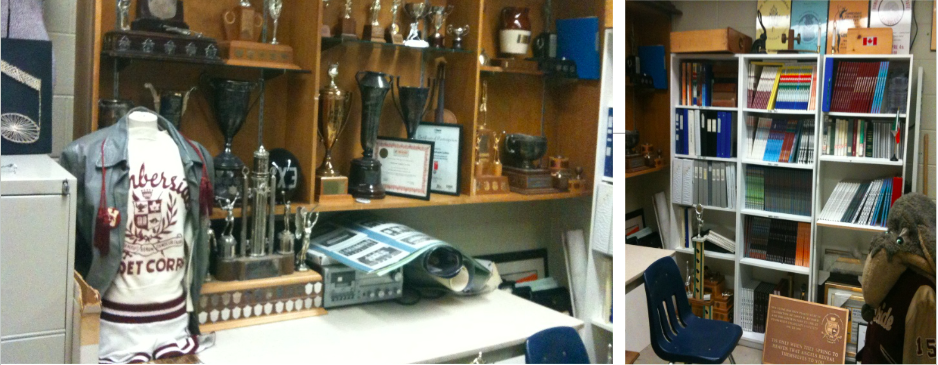
Humberside archives used for local history and school archival work in IC4UI. Photo provided by Dr. Fine-Meyer.
Her current practice emphasizes the interconnectedness of historical events. “I want lessons to be shaped by the way events that happened in the past are not siloed from one another, nor disconnected to today.” This approach prioritizes connecting with the land, and incorporates Indigenous philosophies and ways of knowing.
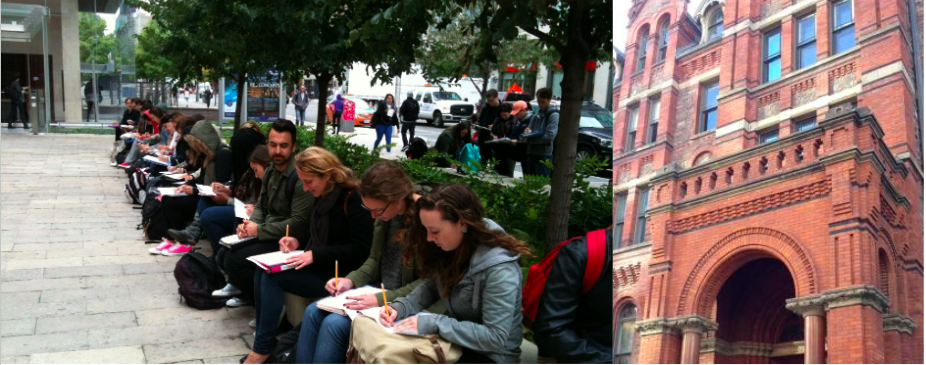
Teacher candidates sketching and writing stories outside of McMaster Hall, helping histories come alive outside of the classroom. Photo provided by Dr. Fine-Meyer.
One example of this is a task on the fur trade. After students explore land, water, animals, and Indigenous history through documents and maps of fur trade regions, Dr. Fine-Meyer assigns students roles, such as canoe makers, trading post workers, exporters, beavers, women & children, and rivers. Students debate questions, such as: “Who played the most essential role in the fur trade?” This expands their understanding beyond the “singular story” of the fur trade that is often taught in schools. It also helps students grasp the interconnectedness of actions, as well as the importance of this history in setting a precedent for state environmental extraction for profit.
Dr. Fine-Meyer stresses that teachers shouldn’t solely rely on textbooks or pre-existing narratives: “You have the agency to bring in more, and so do your students. Your students have stories; let’s bring them into the study of the past.” She models this by using “evidence boxes” with historical documents and artifacts in them to demonstrate how different accounts can be constructed depending on the evidence used.
She also prioritizes field work to sites like historical houses, museums and villages to critically examine curated histories and envision more inclusive and accurate representations. In some cases, field work can occur in students’ own backyards, such as with the mini archaeological digs. She notes, “The idea is to make history relevant because they’re engaging with and reflecting on public and personal spaces that share historical narratives. There’s no line where the past fully stops. By making these connections, they see the way history is alive.”
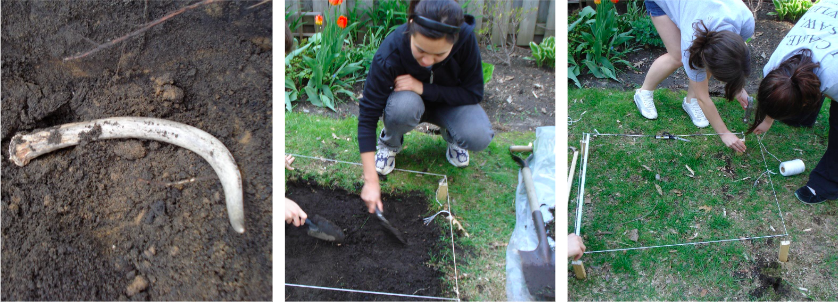
Teacher candidates take part in mini archaeological digs in their own backyards. Photos provided by Dr. Fine-Meyer.
Navigating the Complexities of Teacher Preparation
Dr. Fine-Meyer acknowledges that transforming teaching mindsets “takes time.” She recognizes the challenges teachers can face with extensive fieldwork, and how pre-service teachers might perceive it as “disconnected from their reality in a classroom.”
To address this, Dr. Fine-Meyer advocates for increased professional development opportunities, and notes that the lack thereof is a growing concern. She emphasizes and advocates for local, provincial, and national events where history educators can collaborate and share ideas. Dr. Fine-Meyer is hopeful that this collaborative and interdependent approach can alleviate pressures in schools, stating, “We can’t change everything. We can only change what we do and how we collaborate and outreach as educators.”
Co-created by Dr. Rose Fine-Meyer and Jessica Gobran