
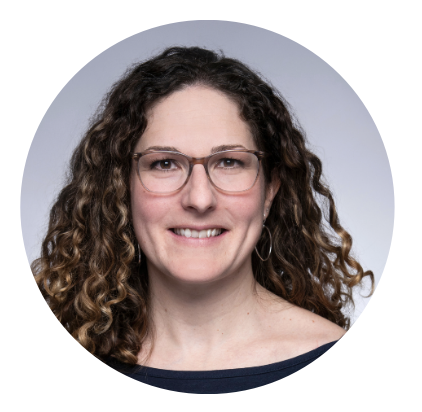
Dr. Marie-Hélène Brunet
University of Ottawa
Ms. Brunet is currently an Associate Professor in the Faculty of Education at the University of Ottawa. She completed her doctorate at the Université de Montréal, focusing on Quebec high school students’ understanding of women’s history. More recently, she has taken an interest in teaching in the Franco-Ontarian community, where she teaches history methods.
Curriculum in Context
Now working in Ontario, Ms. Brunet had to move away from her Quebec experience to adapt to a new institutional and pedagogical context. When she took up her new position, she realized that not only did school programs vary from province to province, but that within Ontario, they also differed according to the language of instruction. For example, history programs designed specifically for Ontario’s Francophone schools incorporate expectations and content related to the history, culture and identity-building of Franco-Ontarian communities. In a Franco-minority environment, the cultural approach is particularly pronounced, which means that teachers have a dual mandate: “to transmit disciplinary knowledge while supporting students’ Francophone identity”. This reality has led Ms. Brunet to pay close attention to the experience of her students, many of whom are driven by the desire to bring Franco-Ontarian history to life for their students.
From Theory to Practice: Curricular Goals in Action
One of Brunet’s objectives in her courses is to develop a reflective posture on the teaching of the past in her pre-service students. This is why she sets up activities to deconstruct common conceptions of what it means to “teach history well”. From the very first classes of the session, she uses an interactive survey to probe initial representations, asking questions such as: “What makes a good history student or teacher?” and “What is history?”. Based on the anonymized responses, she initiates discussions on the place of narrative, the teaching posture and the purpose of history teaching. This discussion encourages teachers to move beyond the image of the teacher-storyteller.
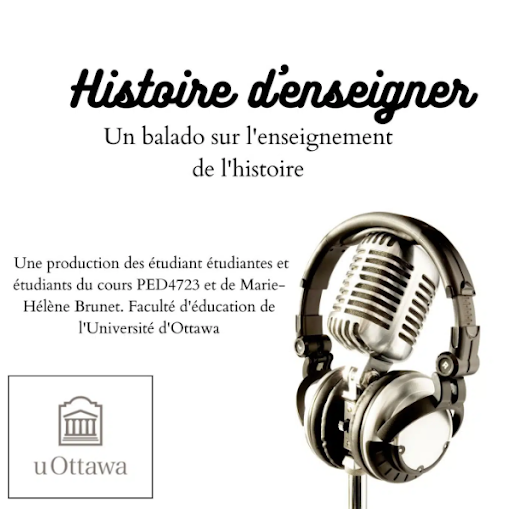
Ms. Brunet has also designed a podcast project (https://voiced.ca/project/histoire-denseigner/) inspired by her colleague David Scott (University of Calgary). The project culminates in a meeting between students and professors in social studies education or historians. Beforehand, the students analyze the guest’s texts, draw up an interview guide and then record a podcast episode in the studio. For Ms. Brunet, this approach fosters the appropriation of research knowledge and its connection with practice. Ultimately, this project positions students as participants in the field, contributing to the circulation of professional knowledge and the development of their professional identity. In this respect, Ms. Brunet points out that future teachers are “not outside the field, they’re not just in the classroom to listen to experts, but also to immerse themselves in the field and take part in it”.
As far as historical consciousness is concerned, it is integrated through the identity, citizenship and ethical dimensions of history teaching, particularly marked in a Franco-minority context. Although Ms. Brunet’s teaching focuses more on historical thinking, historical consciousness is woven throughout her practice when she discusses perspectives and the ethical dimension: “it’s a concept that’s there naturally”. This can often be explained by the teaching context, where many students are already actively engaged in their communities.
Navigating the Complexities of Teacher Preparation
Many aspects of training future teachers may seem complex. However, in a Franco-minority context, the lack of specific resources is often perceived as a major challenge. To remedy this, Ms. Brunet favors active, collaborative pedagogies in which textbooks are critically explored and varied sources become the basis for the development of pedagogical resources. She therefore tries to make future teachers understand that the absence of suitable material should first and foremost be seen as an opportunity to access greater professional autonomy and create relevant resources.
In addition to this, the management of sensitive subjects in the classroom was also mentioned as a challenge: “I’m always thinking things through, there’s no recipe. Sensitivity can’t be invented, it has to be lived”. These questions, however, fuel in-depth discussions with future teachers about the voices included or marginalized in different historical narratives.
Finally, she reminds us that working in a minority context also means learning to teach with awareness, creativity and commitment, even (and especially) in the absence of a ready-made framework.
Co-created by Marie-Hélène Brunet and Arianne Dufour