Dr. David Scott
University of Calgary
Dr. David Scott is an Associate Professor in Curriculum and Learning at the University of Calgary’s Werklund School of Education. His work as a social studies specialist is informed by nine years of teaching experience in BC, Alberta, Japan, and Quebec. Dr. Scott has been working in the area of teacher education for over 15 years.
Curriculum in Context
Dr. Scott’s research on how teachers and the public respond to curriculum change, including calls to carry out the TRC’s Calls to Action, has attuned him to the dangers of curriculum becoming politicized. This is what has occurred in Alberta, where a forward-thinking social studies program introduced from 2005-2010 has been recently replaced with a new program of study that has sought to turn the clock back on hard-won curriculum gains based on “fears of turning students into social justice warriors.” While the 2005 program was rooted in a transformative vision of citizenship, skills-based inquiry, and the teaching of Francophone and Indigenous perspectives, the new program prioritizes knowing historical facts with limited opportunities to engage with the ways in which histories are narrated differently across communities.
Given these challenges, Dr. Scott acknowledges the potential benefits of the new social studies program’s lack of specificity in some areas, which offers flexibility for educators to apply their professional judgement and pedagogical knowledge in how they will take it up. His work as a teacher educator aims to empower pre-service teachers to learn how to creatively interpret the curriculum in ways that will be meaningful and relevant for themselves and their future students.
From Theory to Practice: Curricular Goals in Action
Dr. Scott incorporates experiential and place-based learning into his social studies methods courses to guide and challenge pre-service teachers to think about how history is not just in textbooks but embedded all around us in our cultural landscapes. This approach to teacher formation was exemplified in his assignment entitled, Relational Encounters with a Public Monument or Mural Photo Essay, where the class travelled downtown to engage with a monument or commemoration of their choice. Dr. Scott challenged his students to consider how these sites of memory shape their historical consciousness by considering what stories are being told and not told, and how we come to relate to these stories.
Dr. Scott recounted one group of students who chose to investigate the Women as Persons sculpture in the Olympic Plaza that commemorates the contributions of the ‘Famous Five’who fought for women to be recognized as ‘persons’ under Canadian law.
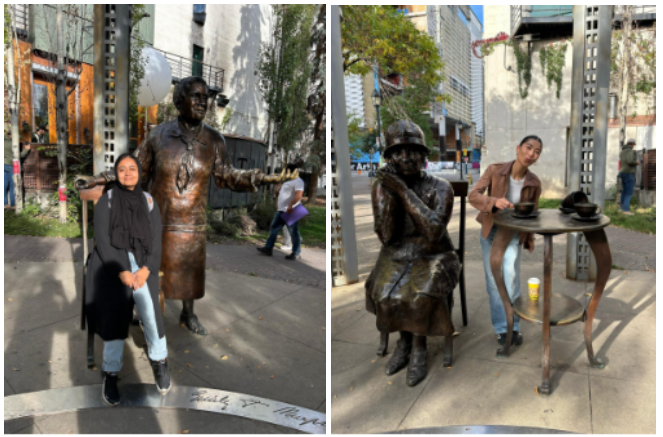
Women as Persons Sculpture, Olympic Plaza, Calgary. Photographs provided by preservice teachers Gabrielle Cabral Palanca, Nazish Malik, and Katherine Mechura, July 2025.
One of the insights this group took away concerns the complexity of historical narratives. While this monument omits narratives around the way the Famous Five excluded many women from their movement on the basis of race, it creates space for female representation and collective agency that are rarely present in our historical cultural landscape. As Dr. Scott asserted, “students are able to reflect on the struggles of those involved and how history directs our attention to certain narratives while excluding others.”
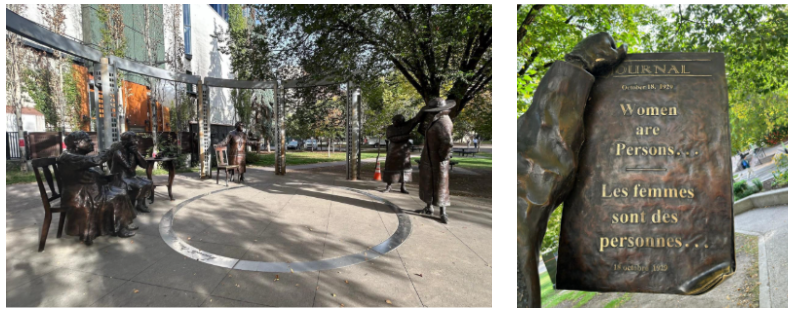
Women as Persons Sculpture, Olympic Plaza, Calgary. Photographs provided by preservice teachers Gabrielle Cabral Palanca, Nazish Malik, and Katherine Mechura, July 2025.
Dr. Scott explains that teaching through the lens of historical consciousness, where history is seen as not just about the past, but the present and future as well, helps pre-service teachers see how historical narratives communicate profound messages about the nature of the world and our place in it. He clarifies that the goal is “not necessarily saying you need to think in this way, but to help students understand what historical narratives are doing to you.”
His teaching design seeks to meet a number of curricular goals, including the need to address the perceived ‘distance’ of history by inviting pre-service teachers to connect to place, and more deeply considering how history functions in our daily lives. Through identifying appropriate strategies for their own classroom contexts, he invites pre-service teachers to respond to the question “What would you do with a group of your own students at a local historical site?”
Navigating the Complexities of Teacher Preparation
Dr. Scott acknowledges that since COVID-19, the dynamics of university education have changed, particularly as students navigate economic pressures alongside their studies. This has influenced classroom structures, including groupwork, which now requires more intentional design to ensure students can rely on and support one another effectively. In response, Dr. Scott proposes the need for tools such as group work rubrics. These rubrics, however, represent only one piece of a broader transformation needed to meet the evolving realities of teacher preparation in a rapidly changing educational landscape.
Dr. Scott proposes that teacher educators can help pre-service teachers better mediate the theory-practice divide by having them participate in and then unpack mock lessons. In this way, we can better “understand the connections students are making, and respond through meaningful feedback.” This process, according to Dr. Scott, should not only foster pedagogical knowledge but also spark critical reflections on the types of educators they aspire to become.
Co-created by Dr. David Scott and Tracy Dinh