
Dr. Dale Ripley
University of Alberta
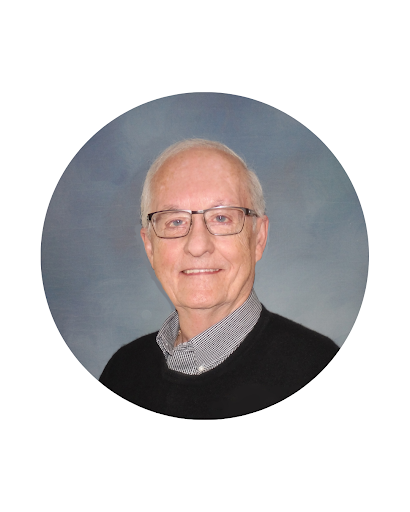
Dr. Dale Ripley, a lecturer at the University of Alberta, has taught social studies curriculum and pedagogy for the past ten years. He draws on his K-12 teaching experience to help future educators prioritize classroom needs through meaningful relationships.
Curriculum in Context
When asked about the curricular context that influences his practice as a teacher educator, Dr. Ripley responded candidly: “they don’t.” He explains that he views the curriculum as a “political document” that reflects the ideology and priorities of the government that put that particular curriculum into place.
Reflecting on Alberta’s 2005 curriculum, he highlighted the collaborative mindset of political actors at the time, who, through consultation with educators and relevant stakeholders, created a “workable curriculum.” In contrast, he criticizes the development of the current social studies curriculum for its lack of collaboration and clarity around expectations for educators and students. “It was god awful,” he says. “So I changed the way I taught my curriculum course, and I taught passive resistance as an implementation model.”
Rather than focusing on strict adherence to the program of studies, Dr. Ripley teaches “curriculum in a sense,” grounding his approach in what he calls the triage of education. He poses three guiding questions: “Where are these kids at? Where can I take them next? What do they need?” Only after answering these three foundational questions does he prompt students to explore which curriculum elements support meaningful learning.
From Theory to Practice: Curricular Goals in Action
Within his teaching context, Dr. Ripley emphasizes the importance of story in shaping and conceptualizing history. When introducing historical thinking to his students, he begins by breaking down the word history into “hi” and “story,” which then evolves to “hi story or hello story,” symbolizing how stories introduce and frame our understanding of the past. He explains, “You have to understand that history is not what happened in the past. It’s the stories we choose to tell ourselves about what happened in the past. Who’s the storyteller? What was their agenda? What perspective do they have? Whose voices are missing that ought to be there?”
These same questions are embedded in his “historian-interviewer” activity, where students pair up and assign one to take on the role as the interviewer and the other as the participant. Starting with the question, “What did you do yesterday?” students describe their day while the interviewer takes notes. Dr. Ripley then asks the interviewer to share what they recorded, which typically includes basic facts like, “I got up, had breakfast, and took the bus to school.” He follows up with deeper questions, “What time did they get up and why? What did they have for breakfast? Why that breakfast?” This activity reveals the selectiveness of historical narratives and helps students practice the critical questioning essential to historical thinking, equipping them to “read history differently.”
When asked about historical consciousness, he takes it up in his context of teaching K-12, sharing, “If you know the names and the dates of these dead white guys, it’s irrelevant to me.” Instead, he expects students, including his pre-service teachers, to focus on “what these people did, how they lived, what they taught, and said. This whole history course is not about the past. It’s about you, now and in your future.”
To elicit this understanding from his students, he engages them through another activity called “mission-vision”, inspired by Theodor Adorno’s radio broadcast in Germany on April 18th, 1966. Adorno begins with the line, “The premier demand upon all education is that Auschwitz not happen again . . . Every debate about the ideals of education is trivial and inconsequential compared to this single ideal: never again Auschwitz.” Dr. Ripley explains that in three simple yet extremely complex words, “Never again Auschwitz,” we can encapsulate the purpose of education: “to use knowledge for good as opposed to for evil.” He then challenges students to create their mission-vision statement: “It’s not big, it’s not flowery,” but it centres the purpose on why we must think historically and become historically conscious.
Navigating the Complexities of Teacher Preparation
A common obstacle Dr. Ripley identifies is helping students navigate classroom management challenges. He emphasizes that most behavioural issues can be addressed by prioritizing strong relationships, stating, “kids don’t misbehave IF your lessons are fun, engaging, relevant … they see you come in excited, eager, knowledgeable, and you care about their success.” He highlights the importance of centring student voices, choices, and experiences in lesson design and delivery.
Dr. Ripley also shares a resource: Lessons From Great Teachers to Teachers Who Want To Be Great, his book featuring strategies from successful educators on topics such as assessment and relationship building. One teacher, Cindy Tran, tells her students, “I don’t care if you’re a 60 percent student, or a 90 percent student. If you tell me ‘I’m in this course and I need to get a 60’, then I’ll help you get a 60. You set the goals for yourself.” Dr. Ripley concludes, “It’s that kind of conversation that makes them feel important … I need the relationship to work for both of us if I’m going to be successful teaching you.”
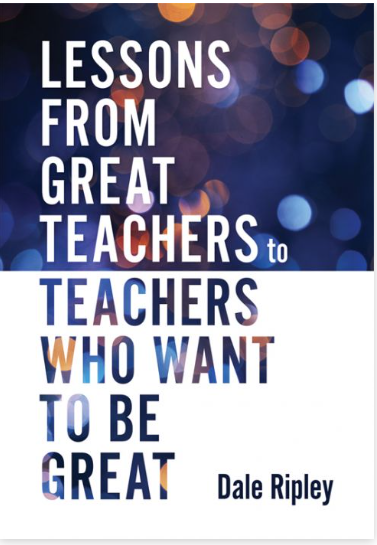
Image of Dr. Dale Ripleys’ book, Lessons From Great Teachers to Teachers Who Want To Be Great Teachers
Co-created by Dr. Dale Ripley and Tracy Dinh