Dr. Becca Evans
Queen’s University
Dr. Becca Evans recently completed her PhD at Queen’s University in civic education. She was also a sessional instructor in the Queen’s Bachelor of Education program, teaching historical and philosophical foundations of education and environmental education courses.
Curriculum in Context
The historical and philosophical foundations of education course that Becca teaches is a mandatory course in the Queen’s teaching program. Through this course, she supports pre-service teachers in understanding the stories and driving forces that shape their teaching contexts, emphasizing that they can be agents of change within the education system. “Examining these stories from the past, which we carry with us whether we realize it or not, helps us better understand who we are and consider who we want to be in the future as educators,” she notes.
Becca holds awareness that the Queen’s teacher education program is composed of a “predominantly white, female, and affluent demographic,” although there is an increasing number of Indigenous and racialized students enrolling. She also observes that the course itself, which can be traced back to early iterations of the Teacher College at Columbia University, is “colonial in nature” and traditionally emphasizes dominant narratives and conceptions of the history of education. Becca challenges these colonial aspects by encouraging teacher candidates to develop “habits of questioning so they can learn about the multiple conflicting storylines that continue to influence the present.” This approach requires engaging in reflexivity in an ongoing way: “As a white, non-Indigenous woman, researcher, and educator, I am careful with how I integrate storylines from equity seeking groups. I hold awareness of how historical storylines have different meanings for learners of diverse identities.”
From Theory to Practice: Curricular Goals in Action
Central to Becca’s work with pre-service teachers is reflection on how individual beliefs and assumptions about the education system drive teaching practice. By reflecting on these deeply ingrained beliefs and considering which aspects of their beliefs they can challenge and leave behind, pre-service teachers can begin “to see themselves as change agents that can go into the system and shape the future of education, starting with themselves.”
To facilitate this, Becca invites pre-service teachers to consider their own personal storylines. Students are tasked with “thinking about significant events in their personal lives that have drastically shaped or changed their own educational pathways.” This personal reflection then serves as a starting point for teacher candidates to gradually begin “examining broader systems and the driving forces within those broader systems” to understand that the status quo can be changed through collective efforts.
One notable learning activity that Becca employs is an oral history project. Pre-service teachers seek out individuals whose educational experiences differ from their own and engage in live conversations to learn about their unique stories. By reflecting on the similarities and differences between their storylines, this learning activity encourages reflexivity and invites questioning of one’s own assumptions and biases about education. This questioning can then be turned outward to the education system more broadly.
Becca also prompts reflection by inviting students to find relevant metaphors for their practice, which she learned to do when she took this course herself with Dr. Ted Christou. She believes metaphors offer a tangible anchor for reflections on educational journeys and aspirations. Additionally, she utilizes connections to place, such as through a land anchor activity where participants draw a place that is personally and historically significant to them. While she initially developed the activity for environmental education, it lends itself well to the history classroom. Pre-service teachers revisit and annotate their drawings with prompts to reflect on their emotions in relation to historical and environmental topics. Becca sees this activity as “a somatic outlet to help pre-service teachers attend to their emotions in the classroom,” emphasizing the power of “pedagogies that invite attunement to emotions.”
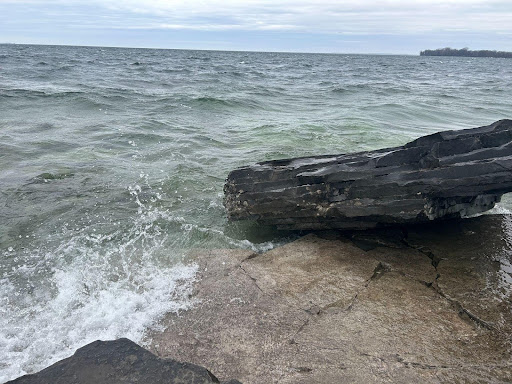
Becca’s land anchor from Lake Ontario Park that she shares as an example to root her inquiry in the local community. Photo provided by Becca.
Navigating the Complexities of Teacher Preparation
Becca navigates the challenge of student expectations in her historical and philosophical foundations of education course. While students often seek neat and predictable dominant narratives, she strives to “balance that with giving them opportunities to develop storylines of their own” that can “decolonize in an ongoing way and centre historically marginalized voices.”
Becca also challenges conventional notions of a historian, moving beyond the idea of a single “expert who can tell a story solely through analyzing primary sources.” Becca seeks “new ways to honour the multiplicity of understandings of what history is,” such as considering how time is conceived cyclically rather than linearly through local Indigenous (e.g., Anishinaabek) worldviews. She reflects that “the field of history has a beautiful way to expand, and with continued efforts, it can be understood as an embodied discipline, rather than just a cognitive discipline.”
Co-created by Dr. Becca Evans and Jessica Gobran